
Learner Supervisor Course
The Learner Supervisor Course (LSC) welcomes eligible WA learner supervisors from across Perth for 90 minutes of face-to-face coaching with Gabriel, for $147. You travel to our Bull Creek meeting point to practise clearer guidance and lesson planning, in automatic or manual at the same price.
Help them learn.
Not dread the next drive together.
You offer a correction. They hear criticism. You repeat the instruction, they get frustrated, and suddenly a simple practice drive has turned into another argument.
You’re trying to keep them safe and help them improve. But knowing how to drive and knowing how to guide a learner are not the same task. What do you say, when do you say it, and how do you stop one mistake taking over the whole lesson?
A clearer way to help
Give the next drive a plan, not just good intentions.
In the 90-minute Learner Supervisor Course, see a practical coaching approach demonstrated, practise it yourself and discuss how to use it with your learner.
- Make instructions easier to act on. Work on clearer guidance without piling on so much information that your learner feels overwhelmed.
- Turn mistakes into something useful. Practise observing, giving feedback and deciding what needs reinforcing, rather than repeating the same correction.
- Know what you’re practising and why. Make sense of the PDA’s five sections, including its two set exercises, and the seven assessment criteria. Use that understanding to give practice a purpose and support your learner’s driving instructor.
See it. Practise it. Take a plan home.
The Learner Supervisor Course (LSC) provides practical supervisor coaching to better supervise your learner, guide a lesson plan and understand the Practical Driving Assessment (PDA): its five sections, including the two set exercises, and the seven assessment criteria used to assess the learner.
It’s hard to prepare someone for an assessment when you don’t know what it involves. We connect the structure, exercises and criteria to what you can notice and reinforce during practice, so you’re not relying on guesswork or how you remember your own driving test.
You are working on your role as the supervisor: what to explain, what to notice and how to plan the next session.
What’s included · Practical help for the passenger seat
Know what to say.
Know what to look for.
Give the next drive a plan.
If “just take them out for practice” were enough, you wouldn’t be here. You want to help, but late instructions, repeated mistakes and different opinions about the right way to drive can leave both of you frustrated.
Bring the situations you find hardest to Gabriel. Use the demonstration, your own drive and the debrief to explore a calmer, clearer way to guide your learner, rather than simply being told to be more patient.
This is coaching for you, the supervisor. Gabriel demonstrates the driving and explains his thinking. You then drive while experiencing his approach to instructions and correction, so you can understand how that guidance feels from the driver’s seat and discuss how to use it with your learner.
Your 90 minutes, put to work.
- 30 minutes: watch the driving and hear the thinking. Follow Gabriel’s commentary demonstration through the five-section PDA-style sequence, including “Stopping for Shopping” and “Left Something Behind”. Connect what happens in those sections to the seven assessment criteria, rather than guessing what the assessor is looking for.
- 45 minutes: experience the coaching while you drive. Take the wheel and experience modelled instructions, observation and correction. Review how the wording, timing and amount of information can help rather than overwhelm a driver.
- 15 minutes across briefing, review and debrief. Set your priorities, discuss what you notice, change seats and finish with feedback and basic lesson planning. These moments are included within the 90 minutes, not added on afterwards.
The coaching connects those practical experiences to the problems you face when supervising:
Less talking over each other. Clearer guidance.
- Instructions they have time to act on. Explore what to say and when to say it, with short, specific directions rather than a last-second stream of corrections.
- One useful focus instead of five things at once. Break a task into manageable steps and match your guidance to what your learner is working on. Give them room to process, rather than adding to the overload.
- Feedback about the driving, not the person. Work on describing what happened, recognising what went well and choosing a useful correction. Make a mistake something to learn from, rather than the start of another argument.
Stop guessing what good practice looks like.
- Hear what an instructor notices. Use commentary driving to connect observations, hazards and decisions. Build a clearer picture of what to discuss with your learner beyond “watch the road”.
- Know how the five PDA sections fit together. Learn the difference between the three sections following the assessor’s directions and the two set-exercise sections, so the structure is no longer a mystery.
- Understand the two main exercises, not just their names. The two set exercises are “Stopping for Shopping” and “Left Something Behind”; each combines two low-speed manoeuvres in an everyday driving situation. See them demonstrated and discuss how to give the underlying skills a purpose during practice, rather than treating them as isolated test tricks.
- Know what the seven criteria are looking at. The seven assessment items are flow, look behind, movement, path, responsiveness, signal and vehicle management. Connect those labels to observable driving, so you have a clearer idea of what to recognise, discuss and reinforce.
- Recognise progress and the next gap. Discuss what is becoming consistent and what still needs work. Use specific observations to support your learner’s instructor and give practice a shared direction. It will also show you if your instructor is teaching the right thing at the right time.
Finish with a plan, not a replay of the argument.
- Give the next lesson a clear purpose. Use a simple lesson-plan structure to choose a skill, a suitable practice setting and a manageable focus, instead of heading out with no idea what to work on.
- A debrief that lets your learner think. Explore the 4 WHATs Method©: what went well, what was different, what they would change and what comes next. Make space for their answers rather than delivering a lecture.
- One useful next-practice priority. Bring the review back to an achievable next step. Leave knowing how to turn what you noticed into the next practice session.
Something useful after the course…
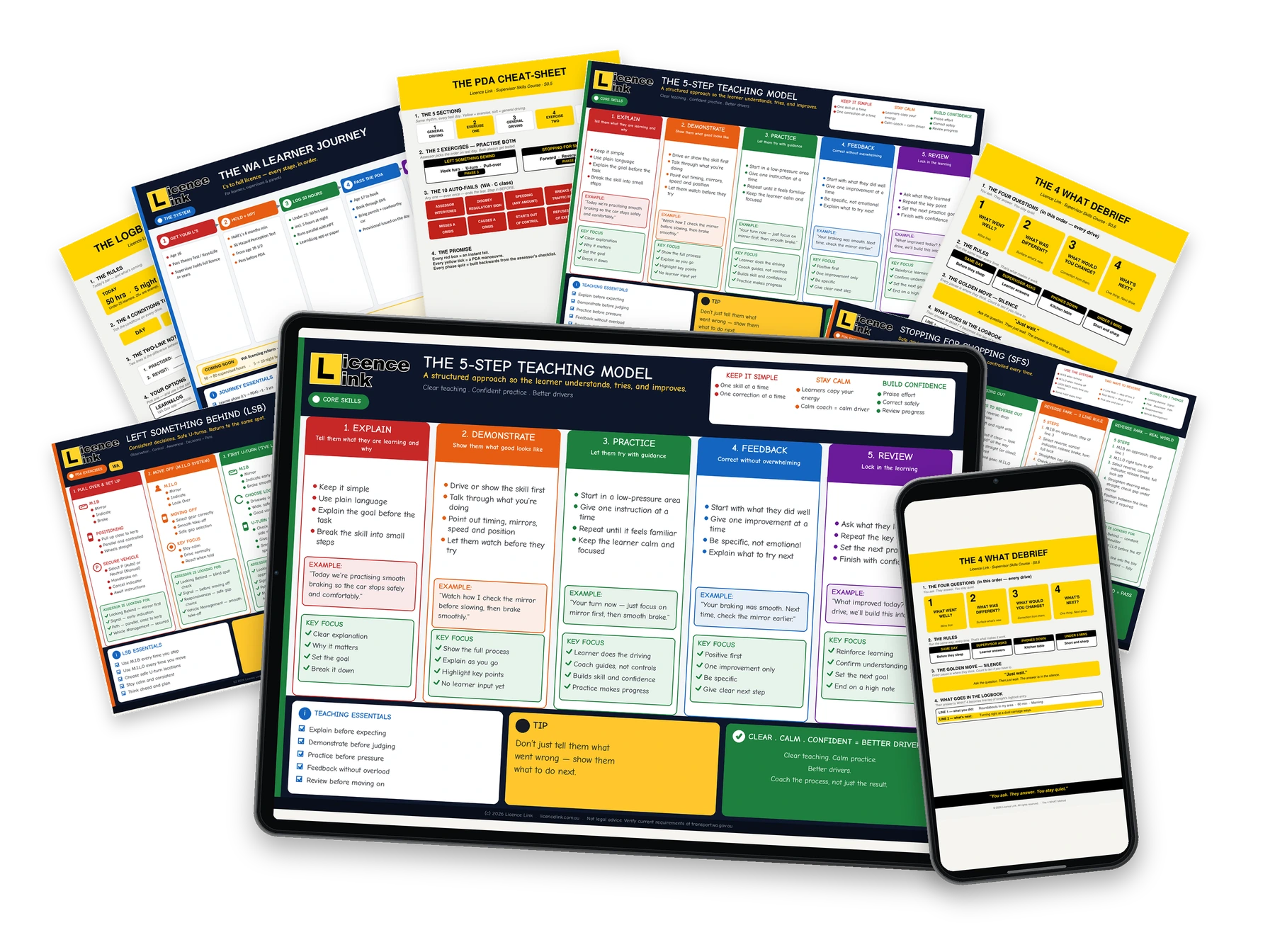
Take a clearer plan into your next practice drive. Your personal digital lesson summary incorporates your feedback and helps you revisit the coaching, while relevant digital cheat sheets and a reusable lesson-plan form help you put it into practice with your learner.
Included in your course price. Yours to keep digitally. Examples from the Licence Link library are shown; your resources are selected for your course and needs.
You don’t have to become an instructor. You just need a clearer way to help.
The aim is to leave with a practical approach to explaining, observing and reviewing a drive, plus a plan you can use with your learner. Your 90 minutes focus on understanding and applying that approach and covering off the required driving skills.
Your personal digital lesson summary incorporating your feedback, relevant digital cheat sheets and reusable lesson-plan form are all included in the $147 course price.
Contact Licence LinkPicture your next practice session
Less tension.
More purpose behind every drive.
Instead of heading out hoping this time will be different, you have a clearer task, a way to explain it and a plan for what comes next. The aim is practice that feels like progress for both of you.
Is this the right course for you?
For people eligible to supervise a learner driver in WA. See a coaching approach demonstrated, practise it yourself and build a clearer plan for the next lesson.
Available in automatic or manual, at the same price, for participants from across Perth. You come to our Bull Creek meeting point, south of the river; your booking confirmation will include the exact meeting spot and arrival instructions.
Clear answers before you decide
Your Learner Supervisor Course questions, answered.
Who is the Learner Supervisor Course for?
The course is for people eligible to supervise a learner driver in WA who want clearer instructions, more purposeful practice and less tension in the car. Use the “See if you qualify to supervise” check if you need help working through the basic licence requirements. It uses your answers; it does not verify your licence.
Who drives during the course?
Gabriel demonstrates the driving and explains his thinking, then you drive while experiencing his approach to instructions and correction. The planned 90-minute format includes 30 minutes of demonstration, 45 minutes of your driving, and 15 minutes distributed across briefing, review and debrief.
How does the course help me understand the WA PDA?
You connect practical driving to the Practical Driving Assessment’s five sections: three following the assessor’s directions and two set exercises, “Stopping for Shopping” and “Left Something Behind”. Each exercise combines two low-speed manoeuvres. You also explore the seven assessment criteria: flow, look behind, movement, path, responsiveness, signal and vehicle management.
How much does it cost, and can I choose automatic or manual?
The course costs $147 AUD for 90 minutes. Automatic and manual cost the same. Contact Licence Link by email to ask about availability. Gabriel will get back to you to discuss the next steps.
Can I attend from anywhere in Perth, and where do we meet?
Yes. Eligible learner supervisors from across the Perth metropolitan area are welcome, including Rockingham and suburbs north or south of the river. Bull Creek is the meeting point, not a limit on where you can come from. You travel to us; your booking confirmation provides the exact meeting spot and arrival instructions.
What digital resources are included?
You receive your personal digital lesson summary incorporating your feedback, relevant digital cheat sheets and a reusable lesson-plan form. These are included in the $147 course price, without requiring a subscription, so you can revisit the coaching and plan your next practice drive.
Your next step
Make the next practice drive more purposeful and less stressful.
All listed resources included
Send Gabriel an email enquiry about the course and your preferred days or times. He’ll get back to you to discuss availability and the next steps.